
Considering that I've only read 25 books this year, it wasn't difficult to narrow it down to a top ten. Looking back on my list, I realize I've somehow lucked out with incredible books landing in my lap this year.
 10. Maus by Art Spiegelman
In 10th grade English class we broke into groups and each read a different book. While I was reading a book by someone named Banana, some of the more ambitious boys tackled this Holocaust graphic novel. I remember thinking it looked interesting when they presented it, but only finally pursued it a couple months ago in anticipation of seeing Art Spiegelman speak here in Seattle. Of course I never made it to the event, but the book was amazing--even if I did cry. Oh, and whenever I read this in public I felt really embarrassed about the huge Swastika on the cover and would always try to hide it. The book is roughly based on the author's parents' experience of the Holocaust (in this book the Jews are drawn as mice, the Nazis as cats, etc.).
 9. The Wilder Life by Wendy McClure
I won a free galley (uncorrected review copy) of this book, and was really excited/surprised to get it in the mail last spring. First of all, the cover is AMAZING. Huge points right there (superficial, yes). The author's writing style really bugged me at first. It's like she's trying to be too casual. Rather like how I'm writing right now. Conversational. But once I got into this book, it really made me want to reread the little house books. McClure writes about finally fulfilling a long-held dream to visit the various homesteads of the Wilder family. She does a great job of mixing history, literature, humor, and poignancy. I knew a bit about Laura before this book, but McClure's is vast and she shares it with us. Yeah, I cried at this one too. Realizing maybe that's how I judge how good a book is.
Erik Larson is freaking brilliant and I've loved everything I've read by him. He spends years researching so you can be assured that every single thing he writes, from the description of a character's bedroom to the weather on a certain day will be footnoted. Granted, In the Garden of Beasts is not as spine-tinglingly wonderful as Thunderstruck or Devil in the White City, but his portrayal of pre-WWII Berlin is eye-opening to say the least. What really stands out in my mind is the feeling I was left with: what happened there could happen again anywhere at any time. Definitely chilling.
 7. Flapper by Joshua Zeitz
Flappers...those carefree girls who wore short dresses and carried cigarette holders and drank gin in basement speakeasies. We tend to think of them as the original feminists. "Yeah! They were breaking the rules and having fun instead of having babies! Girl power!" After reading this book I've come to the conclusion that this may not be entirely correct. It turns out most of them were spoiled sluts with major daddy issues. Ick. In fact, they were looked down on by the suffragette mothers for backpedaling their cause. BUT! This book was really incredible in its scope -- a great look back and what lead up to the roaring twenties from a historical, financial, economic, and social standpoint. I randomly plucked this off the shelf at the library. Hidden gold.
 6. The Psychopath Test by Jon Ronson
This author also brought you Men Who Stare at Goats -- made into a George Clooney movie. I was intrigued in this book after hearing about it on the radio and it did not disappoint. Ronson explores how we define psychopath (or sociopath -- same thing) as he interviews serial murderers and CEOs. This book is really scary, mostly due to the fact that it forces you to think about all the undiagnosed psychopaths out there who are walking among us -- many of them at the top (one trait on the psychopath checklist is an inflated ego). They don't feel sadness, regret, or empathy, but watch and train themselves to mimic "normal" reactions in order to manipulate. There was a time when I thought that not showing your emotions, or even better yet, not feeling those emotions in the first place, was what we were supposed to aspire to. This book left me deeply grateful to be sensitive.
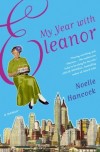 5. My Year with Eleanor by Noelle Hancock
The first few chapters of this book read like something the Sex and the City writers hacked out over lunch. I was unimpressed, but it not only grew on me seemingly overnight -- it also turned out to be incredibly inspiring. Author Noelle Hancock is turning 29 when she gets fired from her job as a pop culture tabloid writer. Having a bit of a one-third-life crisis, she reads a quote by Eleanor Roosevelt "Do one thing every day that scares you" and decided this will be her motto for the year. It doesn't have to be a big thing (on days she realizes she hasn't done her thing for the day, she begins stripping and running down her apartment hallway), but along the way she conquers her fear of heights, sharks, small planes, and even commitment. This experience, interesting history about Eleanor Roosevelt, and sessions with Noelle's therapist are nicely paced throughout the book. It inspired me to think about doing something like this. I said "think."
 4. Moonwalking with Einstein by Joshua Foer
Journalist Joshua Foer (Jonathan's younger brother) was writing a story about a memory championship when he got pulled into competing himself. Lots of good explanations of how the brain's memory works and techniques here. I used one just yesterday when I was trying to remember some things to do before leaving town:
I had to put the auto-response on my work e-mail.
I had to remember to grab lunch for work that day.
I had to return an e-mail about an author event at a garden.
I had also didn't want to forget to pack soap, my toothbrush, my glasses and my contacts.
Using an imagery technique from the book, I combined this into a visual of a car (auto for auto-response) whose "teeth" (toothbrush -- it was an anthropomorphic car, okay?) were being washed (soap) in a garden (the event) while a man an woman sat at a table eating (lunch) -- one wearing glasses and one contacts. It works!
 3. Anna Karenina by Leo Tolstoy
People had been telling me to read this book for years, and I thought I would like it, but hadn't gotten around to it until now. Some complain that books like this are rambling, but I enjoy being able to spread out the reading over six months, picking up the book every once in a while. Makes it more epic. I began last December, and regretfully finished months later. Granted, Tolstoy does wax on about 19th century Russian agriculture (hey, it's okay to skim those parts...), and there is way too much adultery for my taste, but what I love is how well he gets under his characters' skins. When you come across a passing bit of text in a book that makes you say, "yeah, I do that too; I'd never thought about it before," it's a sign of a perceptive author. And when that book is written well over a hundred years ago, it's just astounding.
 2. The Night Circus by Erin Morgenstern
Emily will give me hell for saying this ("omg, Haley, stop being such a hipster"), but I rarely gravitate toward the books near the top of the best-seller lists. If anything, it seems like a sign that they're overrated, dumbed-down, or catering toward ditzy soccer mom types. I read The Help for book club this year (would definitely never have touched that one with a 39.5 foot pole) and was pleasantly surprised. I also happened to begin The Night Circus on a whim, and was drawn into its world. I wasn't crazy about Morgenstern's prose style, but the story changed the way I thought about a few things in my own life. After the first few chapters, the book jumps around in time -- describing a young man and woman who as children are marked as competitors against their wills by her magician father and a mysterious magician who adopts the boy. We discover what their task is along with them (although to be honest I'm not sure if I ever really understood what it is they're supposed to do). It's as difficult for me to describe this book as it is for the attendees to describe the night circus -- with its black and white striped tents filled with exhibits that seem a little too incredible to be made without real magic.
 1. At Home by Bill Bryson
This might be the only history book you'll ever have to own. Bryson launches into "a history of private life" by looking at his own home. For instance, the kitchen chapter becomes a history of how kitchens came to be, food across the ages, cooks through the years, etc. It's absolutely fascinating. I saw him speak at the Seattle stop for this book's tour last year, and he said this book began when he was staring at the salt and pepper shakers on his table and wondered why salt and pepper on the table? Why not salt and sugar? Or cinnamon? If you've ever wondered something similar, this is the book for you.




Hi Haley! Neat books, I thought I'd share a website my sister recently showed me - goodreads.com - to track what your reading. It seems potentially a Haley thing. The Bill Bryson book sounds so cool, but I thought he was a travel writer?
ReplyDeleteHey, silly me, I just found you on goodreads. Sneaky you must somehow be private, but I see the obvious link on the right hand side of the page. How embarrassing!
DeleteYeah, you should be embarrassed. What a horrible faux pas ;)
DeleteI added you!
I've found Bill Bryson's best work is anything that keeps him from talking about himself. The more biographical books aren't as good as ones where he talks about history, etc. His book on Shakespeare is also really good.
DeleteMy sister got me on Goodreads too! She has over a thousand titles on there; it's crazy.